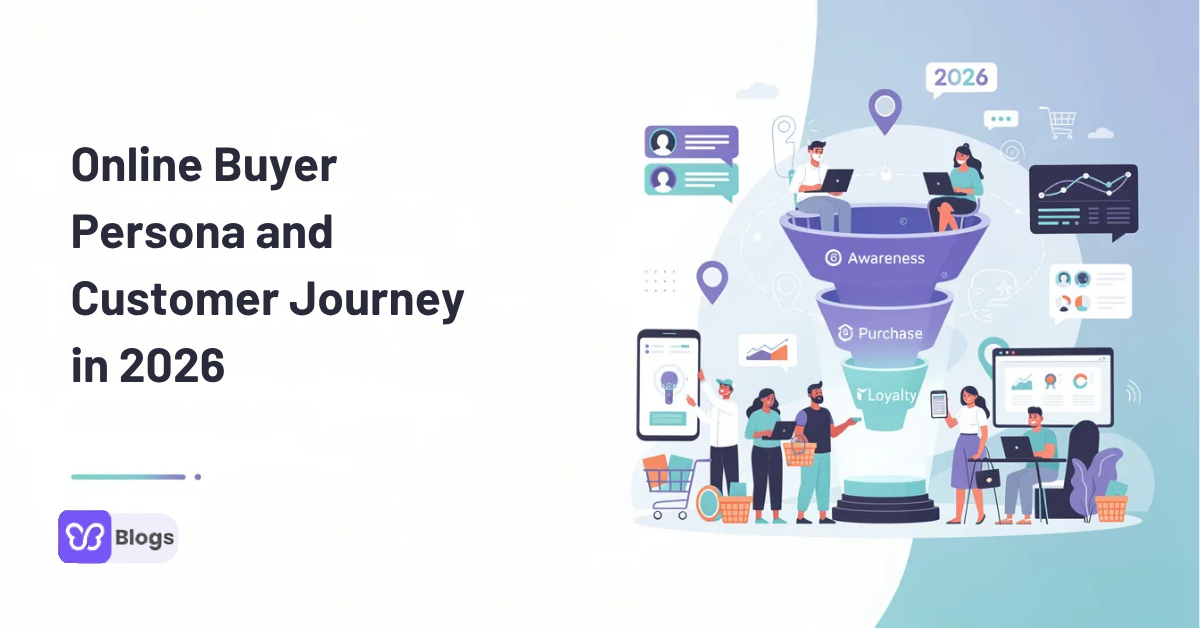
Start with one core persona and one main journey this month rather than waiting for perfection
The immediate revenue wins come from optimizing decision, purchase, and post purchase phase stages—not just creating more content or driving more traffic.
Your action item: implement a persona-based post-purchase email sequence within the next 7 days. Review the impact on repeat purchase rate and customer loyalty after 30 days.
Introduction: Why Online Buyer Personas and Customer Journeys Matter in 2026
If you’re already running campaigns on Google Ads, Meta, or TikTok and wondering why your customer acquisition costs keep climbing while ROAS shrinks, this guide is for you. This is not a 101 primer on what marketing is—it’s a BOFU (bottom-of-funnel) playbook for marketers, founders, and eCommerce managers who need to squeeze more conversions, higher AOV, and stronger LTV from their existing traffic.
The online landscape in 2024–2026 has shifted dramatically. CAC on platforms like Google Ads and Meta climbed 15–20% yearly due to privacy regulations, auction saturation, and cookieless tracking mandates. Relying on third-party cookies is no longer viable. First-party data from your CRM combined with buyer personas and customer journey maps is now non-negotiable to keep ROAS above 4:1.
Let’s define our two core concepts upfront:
An online buyer persona is a detailed, research-based profile representing your ideal customer, outlining their demographics, behaviors, motivations, and pain points.
The customer journey describes the steps a potential customer takes before deciding to purchase a product or service.
Let’s define our two core concepts upfront. An online buyer persona is a research-based, semi-fictional profile of a specific type of digital consumer, built from analytics, surveys, and customer interviews. The digital customer journey is the complete series of interactions across your website, email, social media, ads, chat, and marketplaces like Amazon—from first impression to repeat purchase.
Here’s what you’ll learn in this guide:
How to build data-driven customer personas from real analytics and actual customers
How to map the entire customer journey from awareness to advocacy
How to align both to increase revenue at every customer journey stage
Specific BOFU tactics for decision, purchase, and post-purchase optimization
Unlike generic guides, we’ll go deeper with concrete examples, metrics, and implementation steps you can execute this quarter.
What Is an Online Buyer Persona?
An online buyer persona is a detailed, research-based profile representing your ideal customer, outlining their demographics, behaviors, motivations, and pain points.
An online buyer persona is a research-based, semi-fictional profile of a specific type of online buyer, constructed from hard data (google analytics, CRM records, surveys) and qualitative insights from direct contact with customers. It guides your offers, marketing messages, and channel choices across your digital marketing efforts.
The difference between a target market and a buyer persona is granularity. Your target market might be “millennials aged 25–34 interested in fitness.” Your buyer persona drills down to: “Time-strapped SaaS founder in the US, paying $99–$299/month, discovers products via TikTok ads, purchases on desktop after reading 3+ reviews.”
Here are three real-world persona snippets to show how specific these should be:
DTC Fashion Store – “Trendy Tessa”: 24-year-old urban professional, $50–150 monthly apparel budget, discovers via Instagram Reels (80% view-through rate), objects to slow shipping (deal-breaker for 35% of her segment), converts when she sees user-generated content and trust signals.
B2B SaaS – “Scaling Sarah”: Marketing director at 50–200 employee firms, $5k–20k annual software budget, engages LinkedIn demos after reading 3+ case studies, psychographics emphasize ROI proof over discounts.
DTC Supplements – “Health-Obsessed Hank”: 35, male, $75–200 monthly spend, relies on Amazon online reviews and email nurtures post-cart add, shows 18% higher LTV than average buyers.
Online buyer personas must include digital-specific behaviors: preferred devices (mobile accounts for 60–70% of e-commerce traffic), traffic sources, content formats (short-form video has 2.5x higher engagement than blogs), and buying triggers like urgency timers or guarantees.
For BOFU applications, personas prioritize high-intent users who have visited pricing pages (20–40% conversion lift when personalized), abandoned carts (recovery rates up 10–25% with persona-tailored emails), or downloaded late-funnel assets like ROI calculators.
How to Create Online Buyer Personas (Step-by-Step)
Creating effective customer personas isn’t guesswork—it’s a structured 2–4 week process blending quantitative and qualitative data sources. Here’s how to execute it.
Step 1: Mine Your Existing Data
Start with what you already have:
Google Analytics 4: Identify top countries (e.g., US 45%, UK 15%), devices (mobile 65%), and landing pages with lowest bounce rates
Ad manager data: Meta Ads Manager can reveal best-converting audiences (interests yielding 2.5x ROAS)
CRM and purchase history: Analyze repeat rates, with loyal segments showing 25% higher AOV on 30–45 day purchase cadences
Step 2: Gather Primary Research
Use three primary data sources:
Analytics & CRM for behavioral baselines (session duration correlates to purchase intent)
Customer interviews: 10–15 calls via Zoom yield psychographic depth—pain points like “integration fears” appear in 60% of B2B responses
Surveys via Typeform or Google Forms: Post-purchase surveys achieve 15–25% response rates with incentives, capturing objections like “shipping delays” in 28% of eCommerce feedback
Focus groups can supplement this with deeper understanding of lifestyle characteristics and values.
Step 3: Document Key Persona Attributes
Every online buyer persona should contain:
Demographics (age, location, income)
Firmographics for B2B (company size, revenue, sales pipelines complexity)
Psychographics (values, attitudes toward sustainability or convenience)
Primary goals and customer needs
Core pain points and deal-breakers
Decision criteria (reviews >4.5 stars, specific features)
Preferred communication channels
Common objections during the buying process
Step 4: Segment by Behavior, Not Just Demographics
Behavioral segmentation trumps demographics for BOFU:
Bargain hunters convert 3x during sales (15–20% site traffic spikes)
Loyal subscribers yield 40% LTV uplift via automations
Research-heavy buyers require 3+ content pieces before converting (reducing CAC by 18%)
Example Completed Persona
“Eco-Minded Millennial Online Shopper – Mia”: 28, urban professional, $100–250 quarterly sustainable fashion budget. Goals: build a sustainable wardrobe without style compromise. Customer pain points: fast fashion guilt, sizing inconsistencies. Prefers Instagram/TikTok discovery, mobile checkout with Apple Pay. Objects to non-recyclable packaging. Triggered by eco-certifications and UGC. Primary data analysis shows she reads online reviews before every purchase.
Critical: Revisit personas at least twice yearly (Q2 and Q4) as platforms, behaviors, and economic conditions shift rapidly.
The Online Customer Journey Explained
The customer journey describes the steps a potential customer takes before deciding to purchase a product or service.
The online customer journey represents the full spectrum of digital interactions from initial impression—whether an Instagram Reel or Google search—to loyal repeat purchases and advocacy. Unlike a simple sales funnel, customer journey mapping incorporates emotions, questions, customer touchpoints, and friction points at every step.
This guide uses a 5-stage model that accurately reflects how customers experience your brand:
The BOFU relevance is clear: knowing which stage a visitor is at lets you show the right offer at the right time. A first-time visitor needs education; a cart abandoner needs a guarantee; a loyal customer needs a referral incentive.
Journey mapping for 2026 must account for non-linear behavior. Potential customers jump between channels and devices constantly—60% discover on mobile but complete the purchasing process on desktop. Customer journeys loop back; 40% of buyers abandon and return via retargeting. Your journey map must capture this omnichannel reality.
Stages of the Online Customer Journey (With Persona-Based Examples)
This section breaks down each stage with BOFU-oriented tactics, metrics, and examples. We’ll follow one recurring sample persona throughout: Alex, 32, online fitness equipment shopper in the UK, to keep things concrete.
Awareness Stage
Customer goal: Alex realizes he needs a compact home gym for his small apartment. He’s aware the problem exists but hasn’t identified solutions yet.
Typical online touchpoints:
Google search results (50% of discovery starts here)
YouTube and TikTok videos (40% watch-time predicts stage progression)
Content approach: Educational, problem-oriented content—not salesy. How-to guides, checklists, 101 videos, and quizzes tailored to target customers’ language and search intent.
Persona-mapped content example: “Complete Beginner’s Guide to Adjustable Dumbbells (2026 Update)” drives 2x CTR for first-time home-fitness buyer personas like Alex.
Key metrics:
Impressions and reach
Video watch-time (50% completion threshold)
CTR (1.5–3% benchmark)
Early micro-conversions (newsletter signups, quiz completions)
Website visitors at this stage need answers, not pitches.
Consideration Stage
Customer goal: Alex actively evaluates options, builds a shortlist of 3–5 brands, and compares specs, pricing, and customer feedback.
Typical online touchpoints:
Product category pages
Comparison blog posts (“X vs Y” content drives 30% of traffic)
Case studies and customer stories
Long-form reviews on YouTube
Email nurture sequences triggered by signups
Different customer personas consume different formats here. A technical B2B buyer wants detailed documentation and ROI calculators. A lifestyle B2C buyer like Alex prefers user-generated content and influencer reviews.
This post purchase phase transforms one-time buyers into your customer base of advocates.
How to Map the Online Customer Journey (Practical Framework)
Customer journey mapping is a hands-on process your marketing teams can complete in workshops. Here’s how to execute it.
Step 1: Choose Your Focus
Start with a single primary persona and one high-value journey to keep scope manageable. Example: “Alex’s first-time purchase of £100–£300 fitness equipment.”
Step 2: List All Touchpoints
Document every interaction from first impression to repeat purchase:
Ads (paid social, search)
Blog content and landing pages
Email and SMS sequences
Chat and app notifications
Marketplace listings (Amazon)
Review sites
Customer support interactions
Step 3: Map Emotions and Questions
At each step, document:
What emotion is the customer feeling? (“confused about pricing,” “excited about features”)
What questions are they asking?
What friction points exist? (slow pages, confusing CTAs, missing information)
Simple Journey Map Example (Alex)
Stage
Main Action
Emotion
Primary Channel
Awareness
Clicks TikTok ad
Curiosity
Social media
Consideration
Reads comparison blog
Evaluation
Website
Decision
Adds to cart, checks reviews
Hesitation
Website/Chat
Purchase
Completes checkout with Apple Pay
Relief
Website
Post-Purchase
Opens shipping email, receives product
Satisfaction
Email
Critical: Re-map every 6–12 months or whenever you launch new products, redesign your website, or add new marketing materials.
Setting Goals and KPIs for Your Journey Map
Before mapping, define clear business objectives:
“Raise conversion rate from 2.1% to 3.0% by Q4 2026”
“Increase LTV of Persona A by 25% over 12 months”
BOFU-relevant KPIs per stage:
Stage
Primary KPI
Target
Awareness
CTR from ads/search
1.5–3%
Consideration
Content engagement time
3+ minutes
Decision
Add-to-cart rate
5–10%
Purchase
AOV
£150+
Post-Purchase
90-day repeat rate
25%
Focus on 2–3 KPIs per stage to avoid analysis paralysis. Create a simple dashboard in GA4 or a spreadsheet to track progress against business objectives.
Identifying and Prioritizing High-Impact Touchpoints
Not all touchpoints drive equal value. Use customer analytics to find “hotspots”:
High-traffic, low-conversion pages
Stages with significant drop-off
Ads with strong CTR but poor on-site performance
Prioritization method: Use an Impact vs Effort framework. Start with changes closest to purchase that require low effort.
Concrete examples:
Improve product page load time from 4s to under 2s (+7% conversion)
Add FAQ plus trust badges to high-traffic PDPs (+10% trust signals)
Rewrite confusing pricing table based on customer feedback
Optimize for purchasing power signals (payment options, financing)
Analytics tools like heatmaps reveal where 25% of potential customer friction occurs.
Aligning Buyer Personas with the Online Customer Journey
This is the unification step. Buyer personas and journey maps reinforce each other—never design them in isolation.
Each persona should have its own tailored journey variation with differences in:
Channels: LinkedIn for B2B “Scaling Sarah” vs TikTok for “Trendy Tessa”
Dynamic personalization amplifies results. Using behavior and persona tags in your email tools or CDPs, you can show different headlines (+15% CTR), product recommendations (+20% AOV), and CTAs across your site.
Aligning personas and customer journeys is especially powerful for retargeting, cart recovery, and tailored post-purchase flows. A heavy user gets 30-day replenishment emails; a light user gets 60-day nudges.
Tools and Techniques to Build Personas and Online Journeys (Without Overwhelm)
You don’t need enterprise software to create buyer personas and customer journey maps effectively.
Analytics tools:
Google Analytics 4 for behavior insights (countries, devices, top landing pages)
Heatmaps and session recordings (Hotjar, Microsoft Clarity) to see friction points
Customer analytics platforms for deeper understanding of purchasing decisions
Customer research tools:
Simple NPS emails post-purchase
Post-purchase survey forms (15–25% response rate with incentives)
20–30 minute Zoom interviews with ideal customers
Journey mapping tools:
Whiteboarding (physical or digital)
Specialized mapping applications
Email/CRM platforms that store persona fields and trigger automations based on stage
Best practices:
Start simple—avoid building complex automation from day one
Validate changes through A/B testing and clear KPIs
Document everything in accessible formats your entire team can use
Best Practices for Data-Driven Optimization
BOFU strategy must be rooted in testing. The cycle: hypothesis → A/B test → measure impact → roll out wins.
High-impact test ideas by stage:
Awareness: New hero messaging for top-funnel landing pages
Decision: Different guarantee wording on pricing page (+12% conversion typical)
Purchase: Alternative checkout layouts (one-page vs multi-step)
Post-Purchase: Varying timing of replenishment emails (+18% opens with optimized send times)
Run tests until you achieve statistical significance—typically 1,000+ visits or 50+ conversions minimum per variation.
Keep a simple test log linked to personas and customer journey stages. This enables continuous improvement throughout 2026 and beyond, regardless of shifts in your target market or market research findings.
FAQs About Online Buyer Personas and Customer Journeys
1. How many online buyer personas should my business have?
Most small to mid-size businesses should start with 2–5 high-value personas based on revenue contribution. The 80/20 rule applies: typically 80% of revenue comes from 20% of customer types. Create buyer personas for those segments first. Only expand when you’re actively using existing personas in your marketing strategies and seeing measurable results from personalization efforts.
2. How often should I update my buyer personas and customer journey maps?
Review them at least twice yearly—mid-year and end-of-year work well. Additionally, update whenever a major shift occurs: new product launches, new ad channels (emerging social media platform in 2025–2026), significant economic changes affecting purchasing decisions, or algorithm shifts that change how customers interact with your content. Behaviors shift faster than ever; static personas become liabilities.
3. What’s the fastest BOFU win from persona and journey work?
Three quick interventions deliver fastest results: optimize your top 5 product pages for your best-converting persona (clear value props, persona-specific objections addressed), upgrade cart-abandonment emails with persona-specific social proof and objection handling, and add a tailored post-purchase sequence that drives repeat purchases within 30–60 days. These typically yield 15–30% LTV improvements.
4. How do I measure ROI from buyer personas and customer journey mapping?
Track before/after metrics by persona segment: conversion rate, AOV, CAC, and LTV. Attribute incremental revenue to specific changes that came from persona/journey insights. For example, if persona-tailored PDPs increase conversion from 2.1% to 2.8%, calculate the additional revenue over 90 days. Most teams see 10–25% improvement in key metrics within one quarter of implementation.
5. Can I use the same personas for B2B and B2C channels?
No—B2B and B2C require separate personas. B2B involves buying committees of 3–5 stakeholders, longer sales cycles (60–90 days vs 7–14 for B2C), different consideration stage content needs, and distinct decision criteria. Create distinct buyer persona sets with tailored stages, touchpoints, and content types. A B2B “Results-Driven Marketing Director” needs ROI calculators and case studies; a B2C ideal customer needs UGC and quick-hit videos.
Author
Debutify
Debutify is the easiest way to launch and scale your eCommerce brand.
Share post
Similar posts
Guest post
6 min read
AI in Ecommerce: Separating the Hype from What's Actually Moving the Revenue Needle Right Now